
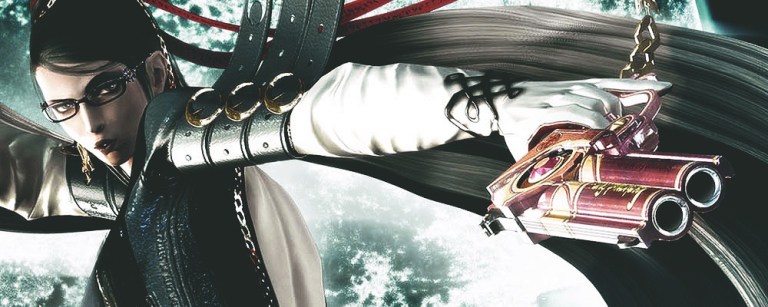
I originally saw a stub article announcing Bayonetta in an import copy of a UK Playstation magazine and rolled my eyes. Oh great, it’s Devil May Cry with a girl, yeah that’ll sell. Who the hell wants to fight with their hair? All the article by-lines were in reference to her ‘ass-ets’. It looked seedy and gross.
Then I played the demo.
I had never been so wrong about a game in my life.
I guess you can’t judge a game by its cover, even if it’s compromised of gratuitous ass shots.
I’m one of those awful people who enjoyed Devil May Cry 4, even with the stupid board game rooms and the backtracking in the latter half of the game. I liked the way Nero handled, the Devil Bringer technique brought a new sense of fluidity into previously static gameplay. But I hated jumping and landing on the same spot. It felt like as soon as you jumped in a combo, it got stilted and awkward. In the end, I still preferred this game over the original Devil May Cry (I hadn’t played 2 or 3 at the time), because it relied less on awful platforming puzzles and underwater missions. Oh, and that one cut scene where Dante just hams it up even more than usual.
The thing that draws me to action games, is the emphasis of never letting you forget you’re playing a game. Somehow it’s more immersive. Chaining combos, grades appearing on screen and ridiculous battle themes come together in something that games developers have been trying to get away from for years in order to ‘legitimise’ themselves. Believe me, I love arty cinematic games as much as the next person, but action games always remind me of why I still play games after all these years. It’s fun.
After I had finished being uppity about Bayonetta being a Devil May Cry clone, I ended up playing the demo for laughs. Straight away, I knew I was in for a treat. When I got into my first battle and practically glided from enemy to enemy, shouting taunts and performing torture attacks – I knew I had found the perfect successor to Devil May Cry. At that point, I wasn’t too familiar with the Clover Studio’s games – I mean of course I knew about Okami and God Hand. I didn’t recognise all the references to other games, or all the weird Sega references that snuck themselves into the game. The film-strip cut scenes were an interesting way to keep you paying attention while the convoluted story attempted to make sense.
Sega published games, particularly Platinum developed ones, tend to go even further into never letting you forget you’re playing a game. Bayonetta revels in button smashing quick time events, an almost constant array of numbers, blood and lens flare flashing on screen at any given time. There’s so much to focus on that you end up lost in the mechanics of the gameplay. Oh boy, and what mechanics they are. Dodge offset, witch time, climax attacks – Hideki Kamiya really went to town on perfecting the action genre. Hopping from enemy to enemy in a constant shower of halos (or Sonic rings, whichever you prefer), turning into a crow or panther at will and taking gigantic weapons from fallen foes – all build up into an insanely fun experience. Though the game suffers from a difficulty spike in the last third or so, the gameplay is so fluid that an absolute novice can pick it up, knock out a few impressive combos and have fun. Yes, it’s a punishing game in parts, but it’s always so worth it for the pay off.
The mission structure of Bayonetta gives it an arcade game feel, and the way the enemies debut the first time you battle them really echoes Sega’s House of the Dead 4. Even the colouring and designs of enemies feels like Sega arcade games. Something about them is kind of ridiculous. Kind of. Hearing Out Run’s ‘Magical Sound Shower’ in a red convertible during the intro, the Space Harrier mini game in chapter fourteen, Rodin’s reference to ‘bald space marines’ – you can tell Platinum enjoyed finding ways to cram all sorts of references that feel a little forced but still give you that ‘aha!’ moment. I couldn’t begin to note all the references in this game, but this wiki did and it’s glorious.
I love Bayonetta’s showiness. It was a great follow up to the rather flashy Viewtiful Joe, the camera flashes and the posing both make appearances. While a lot of people argue that Bayonetta is sexist in its portrayal of its title character, I feel that the behaviour she exhibits is pretty similar to Joe’s flashiness. It truly feels like Bayonetta is absolutely owning the camera, when she turns and poses for it. She regularly taunts enemies in a domineering way in cut scenes, flirting with them and showing disappointment in their attempts to overpower her. She’s confident, but still maintains her femininity – something a lot of games still get wrong. While people continue to debate if her behaviour and looks are vulgar, they seem to be buying back into the common belief that women should be shrinking violets. Bayonetta gets the job done just as effectively as Dante ever did, and with the same showboating we’ve all come to expect from Japanese action games.
I ended up replaying Bayonetta a bunch of times, and even bought my WiiU solely for the exclusive sequel. Which, by the way, might be the most perfect sequel since Terminator 2. Even though the awful narrative still runs rampant in its attempt to make you feel feelings for the characters, I still absolutely adore Bayonetta 2. I don’t want to have any feelings playing an action game unless it’s sheer ostentatious joy. Ignore the storyline in both games, and you have one of the most solid series from a developer that still wants to make video games, and not movies. And I’ll be damned if that’s not commendable in this AAA yearly installment industry that thrives on sequels rather than new IPs.
 Total Recollection