
For my 18th birthday, my friends pitched in to buy me a baby pink Nintendo DS lite and a copy of Animal Crossing. It was a match made in heaven, and the introduction to portable games that weren’t Pokémon. I’d been so out of the loop that I hadn’t had a current console of any kind for nearly six years. The idea that I could finally go out and buy new games blew my mind. I had a very small collection of DS games, I was just basically playing through and trading them in towards a new game each time. It’s through this process that I got to try a range of titles I’d never even considered before. Games like Contact, Resident Evil Deadly Silence, and the Final Fantasy IV remake…the list goes on. It was exciting, I was trying so many different series and I was constantly blown away by all the cool things the system could do.
Then I stumbled upon Hotel Dusk Room 215. Well more specifically, stumbled upon the Touch! Generations portal site for it. It’s still up, by the way. You held the DS like a book! There were puzzles! You could even fuck up the puzzles!
I remember paying $69 for a copy of Hotel Dusk and walking out of the store with an ear to ear grin, and then played it on the bus home. Then I played it for two days straight until I finished it.
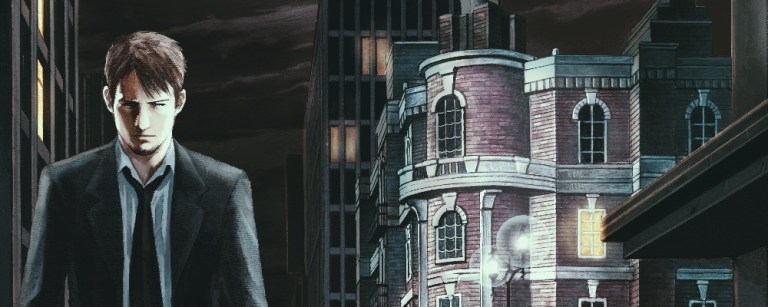
Hotel Dusk is an amazing Japanese take on the hard-boiled genre – from its cynical, disgraced policeman-turned-salesman protagonist Kyle Hyde, to the end-game twist that pulls all the characters together. I’ve played both the English localisation and Japanese versions of Hotel Dusk, and it’s superbly written. The localisation team really put an unprecedented amount of work into something other publishers would’ve palmed off to an intern. Each character has a distinct tone to their dialogue that gives a real feel for who they are without needing voice acting, and while the animation loops are limited, they’re subtle enough to be used repeatedly and still convey a realistic sense of movement. Usually rotoscoped sprites come off as cheap, but it really helped the atmosphere of Hotel Dusk. The loose, sketchy animation style gave the characters a certain liveliness that would have been impossible to do effectively within the limitations of the Nintendo DS hardware.
Hotel Dusk was the first CiNG game I played, but it certainly wasn’t their first game released. While the company originally developed Glass Rose – a point and click horror game — for Playstation 2 in 2003, it wasn’t until 2005 that they got their break with Nintendo when they released Trace Memory (or for us non-Americans, Another Code: Two Memories) for the Nintendo DS just as the rush for non-traditional games became common place.
After devouring Hotel Dusk, I set out to find a copy of Trace Memory. I didn’t manage to find it until I was a casual at an EB Games the following year and someone traded it in. As CiNG’s first foray hand-held development, Trace Memory was really a case of beginners luck. Surprisingly crisp 2D visuals were interspersed with top down 3D navigation and puzzles and manages to avoid being jarring to the player. Trace Memory, as well as the other visual novels CiNG developed for the Nintendo DS, takes full advantage of the hardware. The microphone, the touch screen…hell, even the reflection from the top screen is even required to beat a particularly tough end-game puzzle! They really wanted to get everything they could out of the system, and still manage to make it flow with the story.
See, the story of Trace Memory is unfortunately a little convoluted. While yes, a visual novel should be putting the most emphasis on the narrative rather than gameplay, I felt that the game remained entertaining enough to continue through some pretty ridiculous plot twists. There’s a ghost of a boy who haunts a mansion, also you watched your mom get shot as a toddler and maybe your dad is hiding somewhere on this island? Oh, and both your parents were brilliant scientists working on something top secret. Or something. I dunno. I’ll chalk it up to an overambitious storyline for a game that probably needed to be several hours longer to warrant it.
Hotel Dusk, on the other hand tried to follow a very specific genre of story and nailed it. By this point, CiNG had also become more accustomed to the limits of the system and fine-tuned their touch screen puzzles to include possible failures and alternate solutions. So it doesn’t come as a surprise that the sequel to Hotel Dusk, Last Window: The Secret of Cape West further perfected the formula to a point that it was almost sterile. Don’t get me wrong, I loved Last Window. I loved the little carry over details from the first game, such as the in-game novel written by the author Kyle meets in the hotel. But some of the characters are carbon copy archetypes with a different back story and hairstyle. The Louie/Tony slacker character is probably the worst offender. Last Window had a more streamlined story, and some cool puzzles – but there’s no way it could hold a candle to the greatness that is Hotel Dusk.
It wasn’t soon after the release of Last Window that CiNG filed for bankruptcy and weren’t able to release their final game in territories other than Europe and Japan. Would they had sold more units if Last Window had been released in the US? Probably. Would the impact of Nintendo DS piracy that was at its height in 2009 have been a cause for their poor sales overall? Most definitely.
You’ll notice I’ve left out a key adventure game in their catalogue, Again. I had tried to play this, without even knowing it was a CiNG title because it was so far removed from their aesthetic that I thought it was just some generic visual novel. Again suffers from cheap, photographed visuals that completely remove any immersion in the game. Which is a shame, since the rewinding-a-crime-scene mechanic was actually very cool. It looked like what another developer would have made to cash in on CiNG’s success, instead of one of their own. I believe it was probably Again rather than Last Window that sealed the fate for CiNG. They tried something new, and it didn’t work out. Kudos to them for trying though, there isn’t a hand-held developer nowadays with the guts to do that. That’s what the App Store is for, I guess.
If you can get your hands on a copy of Hotel Dusk or Trace Memory, I’d highly recommend giving them a chance. They’re full of charming (though sometimes cheesy) stories and well written characters.
 Total Recollection