
I’ve had a soft spot for Survival Horror games ever since I first played Silent Hill in my first year of college. When I borrowed my friend’s Playstation 2 all those years ago, I had no idea that I was in the possession of a gateway device. While I had originally borrowed it to play Resident Evil Code Veronica X and subsequently Metal Gear Solid 3 Subsistence, it led me to a treasure trove of survival horror games. My jumping off point was Silent Hill 2, followed very quickly by Silent Hill 3 and then I gradually branched out to other series and a slew of standalone titles. I was overwhelmed by the library of titles for such a niche genre.
It probably helps if I define what Survival Horror is, since it’s been a good few years since an actual Survival Horror game was developed. It’s about being underpowered, having to be resourceful, and most importantly – bizarre fetch quests. A traditional Survival Horror game would most likely limit your capacity to fight back, either through character strength or the availability of weaponry. Resident Evil is often touted as the original Survival Horror game, despite games such as Sweet Home, and Alone in the Dark pre-dating its basic gameplay mechanics and fixed camera angles. But Resident Evil is a pretty good example. While yes, you progressively gain access to more powerful weapons, the ammo for them is scarce. In addition, you have to ration a finite supply of health items and ink ribbons for saving. All while maintaining a 6 (Chris) or 8 (Jill) slot inventory. So while you could technically be armed to the teeth, chances are you’ll only be able to progress a few rooms before having to dump all your guns in favour of a crank or a key to solve a puzzle. The sense of empowerment is balanced with the anxiety of not knowing what inventory combination you’ll need for the next room.
On the other end of the Survival Horror spectrum, you have games where you can’t fight back at all. Being attacked is a game over (or being spotted, as is the case when playing as a young girl in Siren Blood Curse). So the only way to really fight is through evasion. This gameplay trend rose to popularity through the 1995 SNES game Clock Tower. You take control of Jennifer, an easily panicked teenage orphan who is adopted by a mysteriously rich benefactor with three other girls and brought to a rather ominous mansion. The game makes quite a few references to Dario Argento’s Phenomena, even to the point of naming the protagonist after Jennifer Connelly.
Clock Tower is a terrifying game. The first time I played it, I was huddled over my coffee table in my absurdly spacious, echo chamber of a lounge room. It was the middle of winter, and I sat in front of my computer wrapped in a blanket on the edge of my seat. The first few minutes of the game seemed harmless enough, but the tension rises as soon as you decide where to search for your benefactor. The lights flicker off. Your friends disappear. Depending on what route you take out of the main hall, a different girl will be slaughtered in an over the top display by a deformed boy known as Scissorman.
You see, Scissorman is kind of relentless and unpredictable – while there are a number of set piece encounters, he can show up whenever he wants. He usually does, and with a piercing entrance theme that will never fail to give you a heart attack. I had never really been one to scream at a game until I played Clock Tower. It’s been pretty hard to scare me as much since. Jennifer has a panic meter in the form of an on screen portrait in the HUD, some small environmental changes will cause her to worry, and continuously running will make her panic easier. The only way to recover is to crouch for about a minute, while remaining even more defenceless than you’d usually be. So in addition to avoiding Scissorman, you also have to maintain Jennifer’s mental state or it’s game over.
For a late SNES game, it has some pretty nice visuals but still leaves enough to the imagination to come across a lot creepier than necessary. I liked that you couldn’t quite tell what was going on with Scissorman’s face, and don’t get me started on baby Dan. The scene where Jennifer pulls away those heavy velvet curtains to reveal a gigantic, naked demon child was simultaneously horrifying and hilarious. Clock Tower offers a variety of endings that will have you replaying the game several times over to try and trigger them all, from escaping in a car early in the game or taking the opportunity to explore the mansion and uncover the twisted secrets of the Burrows family. Some endings appear solely by chance, and are usually pretty grisly. Take the surprise elevator death for example, or when Scissorman appears in the back seat of Jennifer’s escape car. Oh, and then that chilling ‘DEAD END’ game over screen? I get the feeling that Clock Tower wouldn’t nearly be as unnerving if it was a modern horror game. The combination of slasher film tropes and slow, tense point and click gameplay forms a rather unique experience.
After I finished screaming/sobbing my way through Clock Tower, I started reading into other games in the series. Finding the original Playstation sequels to look too rudimentary, I instead turned to Clock Tower 3, which had been published by Capcom rather than Human Entertainment. Clock Tower 3 is pretty interesting, as it’s part horror, part magical girl story. Oh, and it’s directed by Kinji Fukasaku, who directed a little film called Battle Royale. So naturally, the game is completely over the top in its violence in an almost cartoonish sense.
The game starts when fifteen year old Alyssa Hamilton is summoned back home from boarding school by her mother and somehow transported back to England in World War II by a crazy piano. The plot makes no sense whatsoever, and continues to spiral out of control as you progress. There isn’t really a Scissorman, but there sure are a lot of ridiculous murderous villains.
Departing from the point and click gameplay of its predecessors, Clock Tower 3 features the kind of panning camera angles featured in Devil May Cry and the tank controls popularised by early Resident Evil instalments. This is the first time that the player has direct control over the protagonist. It’s also the first time the player can fight back. After a few encounters with a murderous pursuer or two, Alyssa is told that she comes from a family of Rooders, girls with supernatural powers that reach their peak during adolescence. Their responsibility is to defeat wandering spirits known as Entities and soothe the souls of murdered ghosts by finding cherished objects. It’s really cheesy, but as someone who lapped up shows like Sailor Moon and Cardcaptor Sakura, it was right up my alley.
The majority of each level is similar to classic Clock Tower gameplay, as you’ll find yourself engaged in a constant game of cat and mouse. Alyssa can still panic, but it’s on a sliding meter and thus much easier to manage than in the previous titles. However if she does reach panic, she’ll blindly run and trip over until she calms down. Then you’ll eventually enter a Judgement mode, where Alyssa summons a magical longbow and must bind the Entity multiple times before she can perform a strong attack to exorcise the spirit. It’s a little wacky, but a lot of fun. Except for the final boss fight, which I’ve still never been able to finish to this day. There’s no room for error in this fight, and you’ll find yourself pinned in place almost immediately if you don’t have razor sharp reflexes. Oh, and if you die there’s an un-skippable two minute long game over cut scene before you can try again. I decided it wasn’t worth any more of my rage, and moved onto a different game.
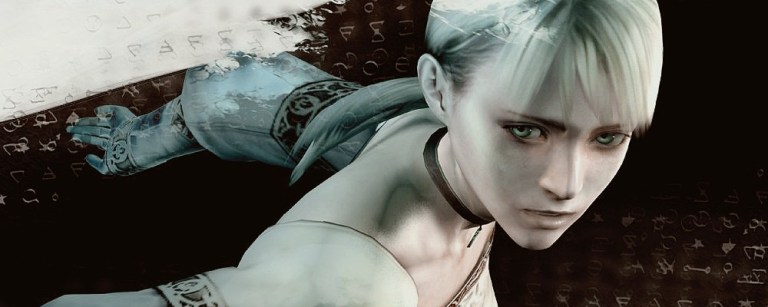
In 2008, it was still pretty easy to find cheap Playstation 2 games around. Good ones too. I picked up Forbidden Siren for only $10, and while browsing the pre-owned section in an EB Games with a friend one lazy afternoon, dug up a copy of Haunting Ground among a shelf of Metal Gear Solid 2 and Grand Theft Auto 3. It’s no surprise that Clock Tower 3 sold poorly, but Capcom loves milking franchises for whatever they’re worth. So naturally there had been a supposed Clock Tower 4 in the works, though at some time during development it went off the rails and became Haunting Ground. It’s basically Clock Tower, but with the addition of a dog. Oh, and it’s a little more disturbing in its content. Just a little.
Fiona Belli is your typical buxom blonde who finds herself locked in a castle dungeon after a grisly car crash that kills both of her parents. She manages to escape, and finds that the castle belongs to her ancestors. Then she teams up with a stray white shepherd named Hewie that she must train to attack enemies and help her solve puzzles. It’s all good and fun until you try to delve a little deeper into the voyeurism of Haunting Ground. If you thought later Fatal Frame games were heavy on the fan service, then maybe Haunting Ground won’t be your cup of tea. Some of the voyeurism is justified through the story, as Fiona is objectified not only for her looks, but that she carries the Azoth – an alchemy related substance that promises eternal life to whoever ingests it. The castle’s keeper, Riccardo is vague about his desire to attain it, though the maid Daniella is jealous of Fiona’s fertility and thinks it will make her a ‘real woman’. The gross voyeurism is pretty stock standard jiggle physics and upskirt shots, though the extra costumes you unlock certainly add an even seedier edge to a lot of the cut scenes should you opt for the dominatrix outfit.
But there’s a tactical advantage to choosing the tacky bonus outfits, you gain a ranged weapon that can stun enemies. So either play on hard mode and retain some dignity, or cheap out and have to explain to every person who walks through the room why you’re wielding a whip in a deep v-neck leotard. Of course, there are a few gag costumes as well, including an absurdly cute frog costume and a stuffed dog suit for Hewie. The panic meter from Clock Tower 3 makes a comeback, though the panic mode is much more punishing. While Fiona panics, the controller will constantly rumble and you can only control the direction in which she blindly runs – if she hits anything, she’ll be reduced to crawling and if she sustains any damage at that point it’s an instant game over. The game over screen is harmless enough, but the sound that plays over the top is pretty disgusting. The crunch of bones, the squelching sound of organs being ripped apart and then depending on the enemy…a series of disturbing moans. They don’t need to show you what’s happening, you just know.
It’s no surprise that the Final Girl trope that is all too familiar to horror film fans would find its way into gaming, though it’s led to a genre with probably the highest saturation of female protagonists. While yes they’re usually weak and objectified, they often rely on wits and resourcefulness, which is a lot more relatable to me than busting into a mansion with a couple of machine guns. Maybe this is why I got so into Survival Horror games in the first place, I wanted to play as characters I could empathise with. And while I may never throw a deformed boy into clock tower gears, cast judgement via a magical longbow, or get chased by a flaming skeleton – the option to experience these adventures as a girl means a lot.
 Total Recollection