
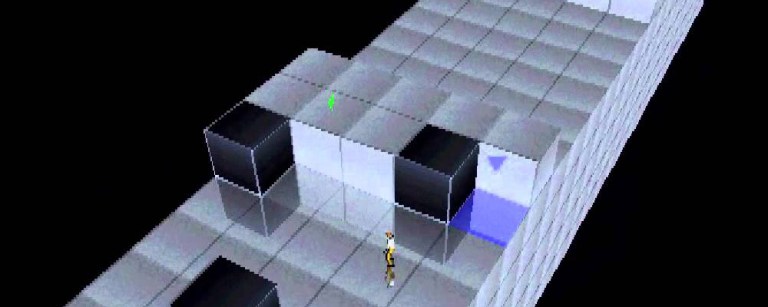
I come back to Demo 1 a lot. I think about the games I was exposed to through that single demo disc, and it’s pretty incredible. There was one game, however, that really stuck with me for all the wrong reasons. But you never killed anyone. There was no visible antagonist.
Intelligent Qube is a 3D puzzle game. You take control of a faceless man, dropped in a black void with a single task. Clear the cubes heading your way. You can clear normal cubes one at a time, and advantage cubes can clear all adjacent spaces. If you clear a forbidden cube, you’ll lose a row of the stage. Oh yeah, the stage will continuously crumble if you make mistakes or if you get trampled by the cubes. Then a booming voice will sound out from the void – ‘AGAIN.’
In the full game, the music is a fantastic, sweeping classical score that almost feels out of place for a game so seemingly bleak. In the demo, there’s no music. The only sounds are that of your footsteps, the cubes approaching and the voice of the commentator. If you run out of space on the stage, it will crumble beneath you and you’ll fall to your death. Then the commentator assigns you an IQ based on your efficiency in clearing the cubes.
As a nine year old trying Intelligent Qube out for the first time, it was pretty terrifying. When you compare its place among other games featured on Demo 1 – Bust a Groove, Abe’s Oddysee, Overboard, Hercules and Lifeforce Tenka to name a few – it seems downright absurd. There’s no action sequences, cool explosions or even fart puzzles. It’s just you, a bunch of cubes and a black void. For an era of gaming based on excess, it’s surprisingly minimalist.
When I played the demo as a kid, I didn’t pay much attention to the tactics of the game and was awful at it as a result. So I really copped it from the omnipresent commentator. The bleak tone and repetitive failure got to me, and I started having reoccurring nightmares. I dreamt I was crushed by cubes and berated from the void. Again, and again. I stopped trying to play it and moved onto sucking at Overboard instead.
Your efficiency is based on how many moves it takes you to clear a wave, with a projected ‘par’ consistently shown in the upper right-hand corner of the screen. If you match the par, you will receive a ‘perfect’ rating and an extra row is added to your stage. If you exceed the par, nothing of particular note happens. But if you manage to clear a wave using less moves than required, you’ll be awarded with ‘true genius’ – and boy, there’s almost nothing more satisfying than hearing that smug as shit commentator having to announce your greatness after throwing endless waves of cubes at you.
Intelligent Qube feels like a test, and the ending confirms that the whole game was part of something much bigger. That said, I’ve never reached the ending myself, and have only the internet to thank for allowing me to watch much more skilled players ascend to greatness. The player escapes, and finds that their trial was part of a simulation to form the universe. It’s just a puzzle game, but gives an air of a sci-fi utopia.
I think my main problem with Intelligent Qube was fear of the unknown. Everything about the way it presented itself was so foreign to me at the time. Minimalist games were few and far between, let alone a puzzle game with a classical score. Or even a puzzle game that reveals an overarching narrative upon completion. There was nothing for me to compare it to, and that’s probably why I was so afraid of it.
I’ve written about non-traditional gaming before, with LSD Dream Emulator. Intelligent Qube was another title released during the deluge of artist-backed projects in a key point in the Playstation’s popularity in Japan. Intelligent Qube was designed by Masahiko Sato, a professor at the Tokyo University of the Arts and artist in his own right, whose recent works tend to feature a mix of organic and digital themes to create interactive installations. He clearly saw the potential the Playstation had to bring more artist driven experiences to the front of the public consciousness.
It’s worth noting that Sony was a bit of a trailblazer when it came to looking beyond the typical gamer demographic in the 90s, particularly in the domestic Japanese market. With mascots like Crash and PaRappa supporting a wide range of genres that, unlike many AAA releases today, didn’t market to a particular gender or skill level. Bringing in artists and musicians from non-tech backgrounds gives a far more broad canvas to develop ideas with, and to push the boundaries of what we could traditionally call a video game.
The inclusion of Takayuki Hattori’s orchestral soundtrack was an unusual choice for the period. While other puzzle games tended to rely on repetitive, catchy loops to hook the player – Intelligent Qube presented a more refined approach. It gave the game a sense of maturity not commonly found in console games. Intelligent Qube pioneered an audio/visual style that would still be seen in Nintendo’s Touch! Generations titles several years down the line.
Years passed and I’d still get a shiver down my spine when I heard sound clips from the game. One day I was chatting to a guy I liked in graphic design college about old Playstation games, and he mentioned Intelligent Qube. I lost it, for several reasons:
- We had common ground
- Someone else actually played this game holy shit
- Goddamn, I’m gonna have nightmares again
- So I’m gonna marry this guy, right?
Turns out the guy was a jackass, but that’s a different story. He reminded me of one of my childhood fears, so I have that to be thankful for. So I looked up some gameplay videos and made it through relatively unscathed. Then realised the sequel, Kurushi Final, was available on PSN. I bid farewell to my last $10 for the week and downloaded it right away.
In the beginning, I was pretty awful at it. But that’s to be expected after ten years. So I watched the tutorial videos, I tried to plan my moves ahead. I got a little better. I even got a couple of ‘true genius’ bonuses, it felt pretty good. Then I got to stage 4 and then the difficulty spiked to a particularly frustrating threshold and I gave up. Because I’m a quitter.
I now accept that I’m destined to never finish Intelligent Qube or Kurushi Final. I think I can live with that. But it’s a great conversation starter if you want to one-up someone in ‘being a 90s kid’. Or if you just want to think of terrifying media involving cubes/black voids/maths that isn’t Cube.
 Total Recollection
1 Comment