
On the first day of kindergarten, we practiced a tornado drill. The other kids in my class thought nothing of it, but I was terrified. I wasn’t just starting school, but I was in an entirely new country. My family had just moved from Canberra to Ohio. I didn’t really know what a tornado was, considering I was from a place that has pretty unremarkable weather. A few weeks later, there was a real tornado warning on TV. My mother freaked out and made my brother and I hide in the basement. We didn’t really know what we were doing. The tornado missed our county, and the storm passed. I was no longer afraid, I was excited.
For Thanksgiving in second grade, we had to make hand turkeys for art class. I don’t exactly know why, but our teacher made us dress them up as what we wanted to be when we grew up. Not really Thanksgiving related, but it was a fun exercise nonetheless. I wanted to be a weather woman. More specifically, I wanted to be a storm chaser. I made my parents buy me books on natural disasters. I became a sponge for information on tornadoes and hurricanes. I’d re-watch Twister at any given opportunity. When we moved back to Australia the following year, my storm hunter hype died down after I realised the only natural disaster I was likely to run into was a bush fire, and even that was pretty rare.
My interest laid dormant for a number of years until I started to play more survival horror games after high school. Blame the notes in Resident Evil, but I started to get really interested in disaster preparedness. I loved the jargon, the liberties taken with scientific and military terms. Like many people who play enough games, I decided I was going to make the best ever survival horror game with absolutely no experience. It never had a title, but the gist of it was – some teen girl wakes up after a train derailment in the mountains and is pursued by a bunch of cannibals. It became a side project on weekends, I designed characters, story boarded cut-scenes and even wrote scripts. But I knew I wasn’t going to be able to actually develop it. So I continued with my research. It started to interfere with my assignments, and I started skipping classes to catch up.
One night towards the end of first year, while I was attempting to juggle a huge branding assignment and reading up on survival handbooks, I came across the guide to end all guides – Nuclear War Survival Skills. By that Kearny guy, y’know, the one who invented the Kearny Air Pump for fallout shel—right, you don’t care. Got it. It’s got a foreword by Edward Teller, that crazy nut who essentially fathered the hydrogen bomb and wanted to create artificial lakes with nukes. The book is crammed with research from Oak Ridge, it’s a damn goldmine.
Interested yet? God, I hope so. I could go on about this for days.
So I stayed up all night, procrastinating on my assignment as I read every page of Nuclear War Survival Skills. I knew I wasn’t going to make the deadline, so I made coffee and huddled back into the lounge room(back when I blew up the fridge, I also blew the power point in the study, so I had to drag my gigantic iMac out onto the coffee table for a makeshift workspace). Enraptured by the soft glow of the screen in the early morning light and the soothing Resident Evil Outbreak soundtrack in the background, I completely forgot about the assignment. There was no time for business cards, I had to learn how to build a bunker. The guide was pretty positive, but also very frank about the mortality and likelihood for survival of its readers. When I read about disposing of corpses, I got really uncomfortable. It was daylight. I felt ill. I used to feel sick after all-nighters most of the time. But this felt a little different. I went to the doctor for a fake-out doctor’s certificate and postponed my assignment. I read some more. I procrastinated some more. Then I had a full blown meltdown and deferred from college. I don’t actually know if the two are related, but it sounds cooler that way. No? Yeah, not really.
Earlier this year when I first started taking medication, I had a bit of a manic episode and went down one of those wiki rabbit holes that I didn’t surface from for two days. It started out harmlessly enough, checking out the cast of the movie SWAT following a recent viewing– then at some point I ended up watching a bunch of Chernobyl documentaries…and then came across Protect and Survive. These videos aren’t anything like Duck and Cover, there’s no cute turtle mascot to be seen. When you compare American and British civil defense media, the American films tend to show life continuing as normal. It’s like your nuclear family is just camping out in the basement. It almost looks fun. British civil defense films are usually bleak, there’s nothing glamorous about it. Particularly when the film starts to cover how to deal with the people who might die in the fallout room. Frankly the most terrifying part is that the creators assumed there would be someone left to give the all clear siren, which sounds just as horrible as the attack warning. Oh, and that awful jingle at the end of each segment gives me chills. It’s no wonder they were never aired publicly at the time.
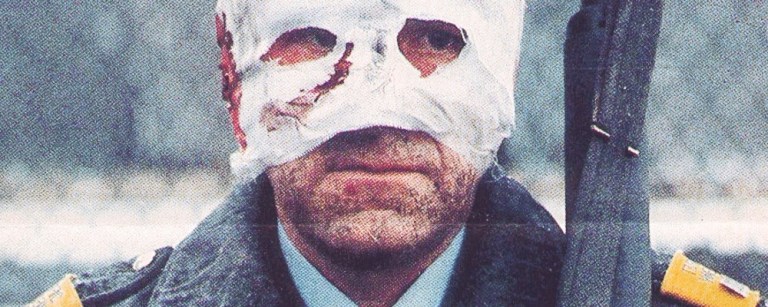
Protect and Survive scared me. I couldn’t sleep. I live in an age and country where the likelihood of experiencing a nuclear exchange is close to zero, but this stuff got to me. I was born just several months before the Berlin Wall came down, but I think about the Cold War a lot. Particularly the early 80s, where public awareness about civil defense waned because everyone just assumed we’d all die anyway. It was during this period that two of the most prominent nuclear holocaust films were released – the American 1983 film The Day After, and the British 1984 film Threads. While the two films share common themes, the time spans they encompass after the attack and overall tone is vastly different.
After rocking myself to sleep in the foetal position after Protect and Survive, I naturally progressed to Threads after reading that some of the clips appear in the movie. The link I originally came across was overdubbed in Russian. It somehow made it worse. Threads builds up the tension slowly, almost tediously, while demonstrating how a Transition to War would work in a real world scenario. Then the bombs drop, and all hell breaks loose. Oh, and a woman pisses herself. The initial panic of the first wave of attacks is still pretty horrifying, even with the gratuitous use of stock footage. The hiss of the firestorm that follows is almost worse. Throughout the movie, background information about the war and the resulting nuclear attacks will appear on screen. Before the attack, each message is accompanied by the sound of a typewriter. Afterwards, they appear in silence. It’s a similar to a technique that featured prominently in the previously unfit-to-be-broadcasted 1966 docudrama The War Game. Even more interesting is that the scenario shown in Threads is based upon an exercise known as Operation Square Leg that was to test government preparedness for a nuclear attack. The outlook wasn’t all that great. Threads is also famously one of the first pieces of popular media to depict nuclear winter, all thanks to the involvement of Carl Sagan.
The first time I attempted to watch Threads, I couldn’t make it more than five or six minutes at once. I’d have to skim ahead or mute scenes. When Ruth makes it to the overrun hospital where a doctor is literally using a saw to amputate a man’s leg, and she walks down a staircase covered in chunks of flesh – I had to shut it off. I had nightmares of course. But I couldn’t stop thinking about it. I eventually found a VHS rip without the Russian dub and it was much easier to watch. I understood the back story better, it wasn’t as scary. As the credits rolled, I sat there with an awful feeling in the pit of my stomach. It was awful. I thought about it for days.
But then something interesting happened. It put things into perspective for me. I was dealing with my own pathetic anxiety issues, I was feeling pretty disenchanted with a lot of things in my life – but they seemed so pointless in comparison to what I had watched. Soon after, my boyfriend and I broke up. I was pretty upset, but then I went home and watched a bunch of Seconds from Disaster episodes and I basked in a glorious numbness that melted away all my first world problems. Then it hit me, no matter how awful a day I was having – it would never be as bad as living in a nuclear apocalypse, hell it wouldn’t even be as bad as being pinned by a collapsed walkway with my feet behind my ears.
I’ve found that getting into these absurdly morbid documentaries is pretty cathartic. It’s an escape from the everyday, one that will usually have me guessing how I’d make it out of a situation. Where it wouldn’t matter that I made an ass of myself in front of my friends, or screwed up at work, or that I’m terrible at dealing with money. It’s a pretty common escape, considering the widespread popularity of zombie apocalypse media. Us middle-class kids sure love to think that we’ll survive outside our comfort zones. But I have no doubts about my survival in the hypothetical apocalypse – I’m resourceful as hell, but I have a short attention span. I will undoubtedly mess up and die pretty early. No shotguns and tins of beans for me. I’m at least realistic in that sense. I, for one, welcome our new artificially intelligent overlords.
 Total Recollection