

Let’s try something a little different, about two years ago I was writing an ongoing retrospective of each Resident Evil instalment for my friend’s (now defunct) website – White Rabbit Object. I thought I would tweak it (and fix some glaring mistakes regarding RE1.5) a bit in anticipation of the remake being released tomorrow, since you can bet I’ll be back with an incomprehensible wall of text about it once I’ve given it a run-through.
So please, enjoy some Classic Recollection™…
There’s just under two years between the release of Resident Evil and Resident Evil 2. Imagine a time in Resident Evil’s existence where there wasn’t any metaverse to capitalise on. No spin-off games, no novels and certainly no films. Two years is an eternity. The only respite early Resi fans had, was a token offering from Capcom – the Resident Evil: Director’s Cut (1997) featuring altered item placement and new costumes – there’s just enough content to warrant a second play through for seasoned veterans. Though the real gem in the director’s cut came in the form of a playable demo of Resident Evil 2.
When Yoshiki Okamoto, the supervisor on Resident Evil 2 found the game to be too conclusive – something Mikami had aimed for as he saw the series ending after two games – he brought in Noboru Sugimura to conceive a scenario that could contain multiple story threads with a wide cast of intertwined characters. The overall plot of a shady pharmaceutical company and its poor practices having impact on countless civilian lives opened up more interesting avenues for storytelling than relying solely on police or military character types that are somewhat more difficult to empathise with.
Resident Evil 1.5 was somewhat of an urban legend, something you would find on the likes of Unseen64. While still featuring Leon as a protagonist, Elza Walker would later be redeveloped into Claire Redfield to better suit Okamoto’s vision. Elza had no connection to any of the established characters, in fact she and Leon were not going to cross paths in their respective scenarios. The visuals were more rudimentary, and the design of the Raccoon City Police Department was much more sterile than the classic design of the final release. In exchange for toned down backgrounds, the development team were able to apply small animations that could alter the fixed backgrounds to make them appear more dynamic. Character damage would also be conveyed to the player through torn clothes and bleeding, something that unfortunately didn’t make its way into the finished product.


The cast of Resident Evil 2 is refreshingly diverse, ranging from a corporate spy to a precocious child. Each character has their own reasoning for being in Raccoon City in a time where everyone sane has either fled or become one of the undead, so no one appears without purpose. The desperation of the town’s plight is evidenced best through the few survivors in the Raccoon Police Department, where whoever remains has barricaded themselves with what little ammunition remains after the police chief confiscates it all to prevent looting (really quite an ingenious answer to the ‘why are there shotgun shells in this fake pot plant?’ question you’ll try rationalising during your journey). The police chief himself is sinister beyond regular Resident Evil standards, where it’s heavily implied that he’s the one who killed the mayor’s daughter rather than a zombie.
The notes and files found around the police station give a much richer background of the lead up to the chaos than the files in the first game did, and it really comes down to the writing style. The files left behind in the first game were all written by researchers or security personnel, where much of the content is presented in quite a stark, clinical way – barring a few exceptions of diary excerpts that shed a more human light on the tragedy. Resident Evil 2 jumps from standard police reports, to newspaper clippings, undeveloped film canisters and of course the ever popular diary entries; but it does so in a way that’s more believable and more effectively shows the passage of time. Not only would you find reports from the early days of the infection spreading across the city, but being able to find a diary that progressively gets more and more despairing with each successive entry, really hammers in how desperate the situation is for the city as a whole.
One of the greatest differences between Resident Evil 2 and its predecessor is mobility within the game environment. Where the mansion of the original game had many narrow, winding hallways, Resident Evil 2’s spaces are wider and give the player a lot more options for strategy. You would have very little luck dodging a zombie in Spencer mansion, but you could probably outrun a few zombies in the Raccoon Police Department. Though there are no glaring differences in control scheme or inherent character abilities, it feels as if the run cycles in Resident Evil 2 are far smoother and as a result, gives the impression of being able to run faster. It almost tricks you into thinking you can outrun any kind of situation.


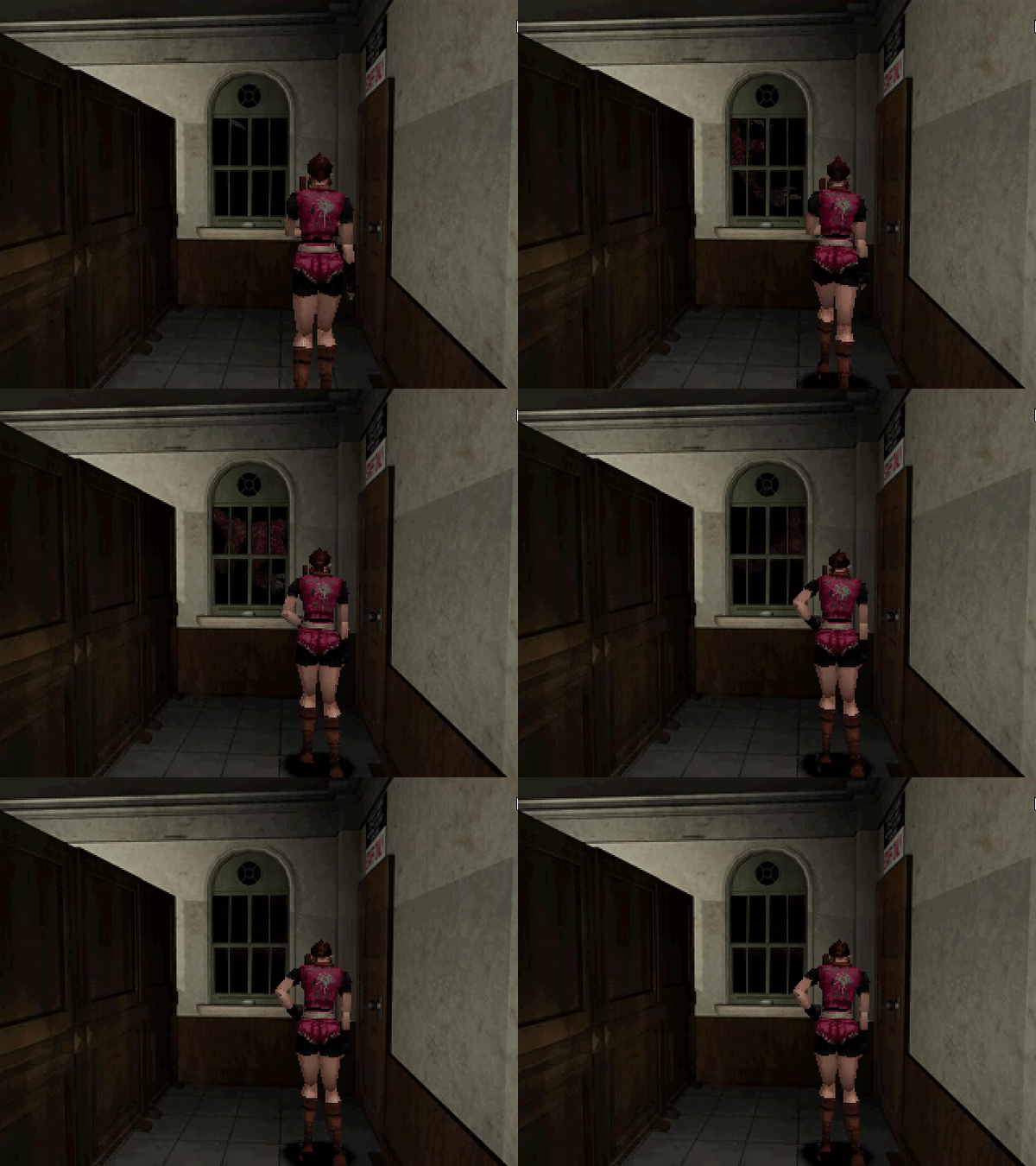
The Licker’s initial reveal in a window is quick, but incredibly effective.
Using full motion video was another thing the developers really gambled with in Resident Evil 2, on one hand – it allowed for more interesting creature design and more interesting cutscenes in terms of camera angles and artistic direction, on the other hand – it looks god awful in hindsight. There’s little to no lip-sync for any spoken dialogue, and Leon’s pre-rendered face looks like a Patrick Nagel painting with sculpted cheekbones and sultry eyeliner.
For a horror game, Resident Evil 2 is absurdly colourful. Even for a time when games weren’t burdened down with ‘brown and bloom’, a town on the brink of destruction manages to come to life in a way that would be lost over the next few instalments as the visual style shifted closer to photo-realism. What Resident Evil 2 lacked in graphical power, was made up in its cinematic presentation; from the use of more varied camera angles, to its lack of a dedicated HUD. The character animation in-game becomes all that more important when you don’t have a visible health bar. By keeping unnecessary information off screen, but still accessible at the push of a button, the developers were able to maintain immersion throughout the game and in turn, keep the tension at a relatively constant high. While it would become necessary in later games to show constant information on screen, be it due to weapons with much higher ammo counts, escort partners or even a T-Virus infection meter.

Layered backgrounds help to add depth to fixed camera angles.
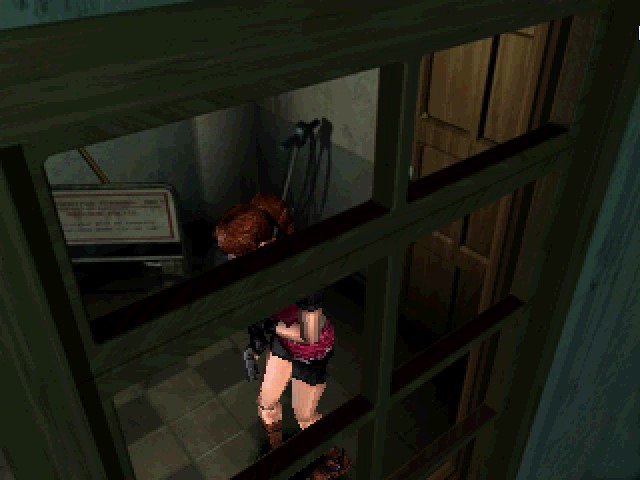
Since these types of camera angles are used sparingly, the tension they create is far more effective. This particular camera angle will only be triggered when the player enters this hall leading up to the first Licker encounter.
Other than character exclusive weapons and minor scenario differences, Resident Evil 2’s multiple campaigns are fairly balanced. Leon’s scenarios are no harder than Claire’s, and vice versa. They both have the same inventory space, a drastically more level playing field compared to Chris and Jill in the predecessor. The real difficulty lies in resource management, which feels much stricter than before. Unless you are checking every possible drawer, you’ll likely be struggling to kill more than a few enemies. The scarce resources really make you want to thank the developers for giving you such freedom of movement to generally run away from most encounters.
The end result in all four scenarios is sadly the same, Raccoon City is beyond saving and Umbrella will continue to get away with experimentation and shifty dealings. Where Umbrella had seemed secretive and fringe in the original game, they are now blown out of proportion and it seems that the entire city is at least somewhat connected to the mega-corporation. Though the focus in this game seems to be on the Raccoon Police Department’s under the table dealings with Umbrella, Resident Evil 3 will go on to show just how tangled up in this mess the rest of this quiet, mid-western town was.
As someone who initially preferred the original Resident Evil, it took me a few years to really appreciate the importance of such a game in the zeitgeist of 90s horror games and while it resembles the original mechanically, paved the way for more innovative mechanics in Resident Evil 3 and subsequent releases. Now I can only hope the remake can do the same.
 Total Recollection