
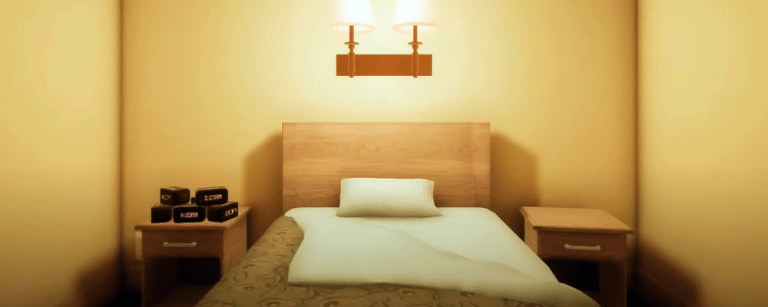
I recently realised I’m a huge sucker for games that deal with dreams, or just the concept of sleep in general. Now that I think of it, I can probably trace this back to my major project from when I was studying game design – a first person, physics-based puzzle game where a young woman is caught in limbo trying to resolve past traumas before she can rest. It probably sounds like a dozen games now, but when we made the alpha in 2011, it seemed pretty exciting.
A couple of years after graduation, I was shown a tech demo where the player could resize objects based on perspective. I was blown away, this is pretty much what I wanted to do! If only I’d kept in touch with my team (sorry Rob, Frank and Thomas!) and kept developing our game like we planned! It looked promising, and I hoped there’d be a game based on the mechanic one day.
Several years and various stages of the pandemic passed, and towards the end of a 107 day lockdown in October last year, I found Superliminal on sale on the eShop. I watched the trailer, wanting to slap myself for forgetting about the development of this game after so long. I downloaded it immediately and jumped right in. Everything about it spoke to me – the soft jazz piano, the mash-up of Frasurbane and Utopian Scholastic interiors, and the somewhat self-aware writing of Dr. Glenn Pierce’s dialogue.
When I wrote about Hypnospace Outlaw last time, I hadn’t made the connection with sleep and dreams as one of the themes that would draw me to it in the first place. But that game, along with LSD: Dream Emulator are two examples of using sleep as a motif in very different ways. Even the concept of being placed in a building block testing scenario is something I’m somewhat familiar with, given my childhood fascination (and sometimes intense fear) of Intelligent Qube.
The opening cinematic starts off in a conventional way, and abruptly shifts to a Tom Goes to the Mayor-style line about the Pierce Institute being “located right next to the secondary overflow parking lot at the University Medical Centre”. Oh boy, this was already promising to be a good time.
I’m dropped into a beige room, with some control explanations printed on the wall. Upon turning around, I found the terms of service and signed. Part of me hoped that you could leave without signing and get an ‘over before it begins’ kind of ending – not this time, but still a cute gag nonetheless.
I progressed into the next few rooms, playing around with the mechanics as they’re introduced. Giggling and gasping at how I could enlarge a wedge of Edam cheese to form a ramp to the next area.
Using ordinary, and often out of place, objects to solve puzzles and traverse different dreams reminded me of books I loved as a kid — the I Spy series. The brightly lit, colourful arrangements of tchotchkes created little worlds that I could stare at for hours at a time, finding more and more layers of detail. These books made some of the smallest trinkets or ordinary stationery feel larger than life, and I’d often wonder if that’s how an ant would feel. Putting smaller objects into this kind of perspective made them feel important, sometimes implying a secondary purpose.
While the clean lines and colours used felt reminiscent of many Unity games, it was warm and inviting in a familiar childlike kind of way. The music is soft, cheerful piano – the kind you’d hear if you went to the Elizabeth St David Jones on a weekend. It feels glossy and a little exciting, just like a sparkling department store. A sense of adventure in four walls, thinking of the exciting solutions I could execute in plush hotel hallways, art deco indoor pools and a dark maze of cardboard boxes.
The initial area is akin to a standard testing facility, getting progressively more complex as you solve each puzzle – ending in a looping hallway before being led to a room where the exit appears to be covered in bricks. A couple of rooms before this, I “deviated from the orientation pathway” to find a cement-walled maintenance hall with a vending machine. The AI scolded me for veering off course into the dead-end, so I had no choice but to get back on track to solve the current puzzle.
So when I came to this dead-end with the brick wall, it seemed as if there was nowhere else to go. Upon inspecting the wall panels, some of them are askew and another large wedge of Edam can be spotted in the distance. I picked up the Edam and brought it into my room, but accidentally knocked down a bunch of the panels to reveal another maintenance room. I was expecting to be told off again. I walked through this storage area to an elevator and hopped inside, only to wake up in my bed at the Pierce Institute – and this is how subsequent chapters will begin, where I would wake up in the institute and walk around the deserted office until the next selection of puzzles appeared.
Around this time, I started wondering – were there any other patients at this facility? Has there ever been? Even though I only heard from the AI and pre-recorded tapes from Dr Pierce, it made me wonder if they were even in the office. Was I being watched from a remote control room somewhere? Was Dr Pierce even real?
The Blackout stage genuinely had me on edge the first time I played it because I was expecting the game to throw me for a 180 and become super messed up. I held my breath as I approached a door with a person’s silhouette and thought “finally! Now it’s a horror game” only to get past the door and find it was an oversized pawn on a block. So many times I would be on pins and needles with tension only to explode in relieved laughter at the punchline of the setup
After the Blackout chapter, it became apparent that the game wanted to mess with me a bit. Not to the length that The Stanley Parable does, it holds back a bit since the focus is the mechanics over the narrative. It’s not to say the narrative is weak, of course, I was moved by Whitespace and Retrospect. When the game climaxed in Labyrinth, throwing a remix of many of the past puzzles that made me feel like I was being chased throughout the halls. The music in this chapter is tense and constantly drove me forward, too scared to look back to see if I missed anything.
One of the most infamous puzzles I came across was the red apple in Clone. Quite often, there are multiple ways to approach a solution, and some of the most fun I had was watching Voidburger’s stream of it to see where our solutions differed. Or how we came to the same solution, but through vastly different means.
I remember really struggling in this room, initially trying to clone apples around the back of the fan, to very little success. I then tried to brute force a solution by cloning as many apples as possible, though there’s an item clone limit in newer versions of Superliminal. Eventually, I sucked it up and looked up a guide…but was still in shock when it ended up working. What a brilliantly simple solution. A lot of these solutions end up being really quite simple when they’re boiled down to a couple of moves. The Challenge mode gave me flashbacks to trying to beat the projected moves in Intelligent Qube to get the ‘true genius’ bonus.
Even when I got frustrated with a puzzle, the solutions never felt unfair to me. I was never left feeling dumb for not getting something, if anything, I felt like a damn genius whenever I worked something out after a long time of tossing dice around.
Whitespace uses negative space and tones in such an interesting way, albeit reusing some similar gimmicks from the Blackout chapter (namely the exit to a room hiding beyond a shadow and marked by small lights). Where previous levels made obstacles out of the objects themselves, Whitespace became a series of environments as obstacles, often relying on the player to test where barriers were and spot red herring exits that loop infinitely.
There is an area in Whitespace that sent me back to the last few nights before I was due to present my major project. Although the environment designer had made realistic furniture models for our demo, I wasn’t happy with the colour scheme he chose, it was all too bright and Tin Toy-like for my initial vision of a hazy pastel dreamland. While running the demo in UDK to check the camera, I removed the textures in the debug mode and was struck by cloud-like masses I was left with. I apologised for wasting his time, but this was what I was after the entire time, if only we hadn’t bothered to create textures! We could’ve got so much more done!
So why did this one area remind me of the failed alpha? After traversing through several interchangeably monochromatic rooms, I came out from an enclosed city block into something resembling a snowfield, covered in large formations that resembled chess pieces and an oversized water cooler. One of the areas we ended up presenting at the showcase and garnered a bit of attention for, was one of my floating cloud furniture spaces – with a floating staircase that needed to be put back together as the player climbed it.
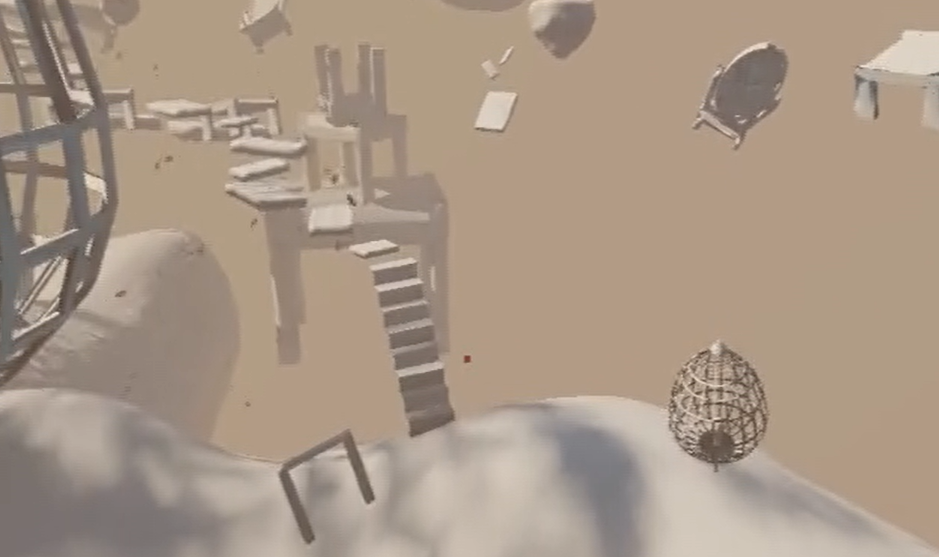
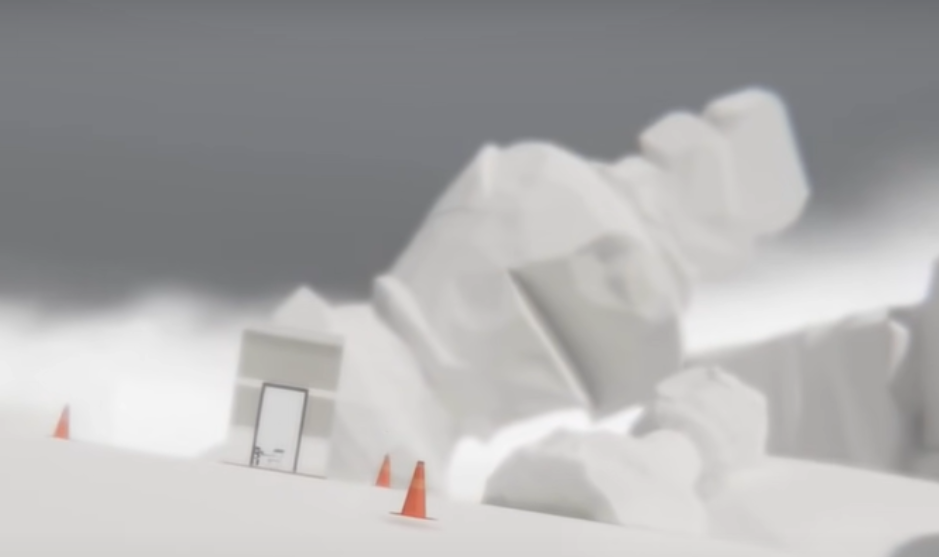
It was bittersweet to see a sight like this in a game that I had enjoyed so much, because it reminded me of not pursuing design jobs after college. After our presentation that night, several industry visitors came up to our desk to ask for my card. In a moment of stupidity, I had gotten a group business card printed with all our details on it – under the premise that we were a package deal and would continue the game as a team after graduation. I still had a couple of emails the next day for some local studios, but I was so burnt out from the previous months of all-nighters and having just wrapped up an internship, that I forgot to reply. The last 6 months of my degree were almost non-stop – between working part time to pay rent, coming into college to work on the alpha and then dragging myself to my internship at a gaming magazine in Surry Hills – I just wanted to catch up on sleep and de-stress.
In Retrospect, Dr Pierce tells the player that although things appeared to be going wrong with the AI and locations, it was all intended – just to see how you would approach difficult situations. I was dealing with my own anxieties after putting my father in jail a few months earlier, and starting to worry what I was meant to do with my life now that I hit a major fork in the road. While gliding back through key areas I had visited, Dr Pierce’s relaxing brogue that had previously washed over me, hit me with a real gut punch “Your life will always be a struggle and you will always have problems. But today, you had the chance to see things differently.”
When I listened to the developers commentary, I really appreciated how they spoke about the end of the game. I thought it was incredibly sweet at the time and I’m glad that they didn’t shy away from the emotional reward in favour of cynicism. I wish more games weren’t afraid to be genuine, instead they often hide behind snark and irony. I wish I had more games like Superliminal that revel in emotional triumph, rather than bring you down with a bummer ending.
After replaying the game a few times to prepare for writing about it, I was relieved to hear Dr Pierce’s speech again, as I find myself less than a fortnight away from a hemithyroidectomy. Even though I’m a little nervous, I just keep coming back to a sweet Scottish man’s voice that will guide the way.
 Total Recollection